Threat intelligence
When AI Becomes the Hacker: The Rise of Autonomous Cyberattacks
How cybercriminals are weaponising artificial intelligence, what real-world attacks reveal and how organisations can defend themselves.
KoshCyber · · 17 min read
Introduction
Artificial intelligence is transforming cybersecurity, but its capabilities are not limited to those defending organisations.
Threat actors are increasingly using AI to identify vulnerabilities, discover exposed credentials, analyse systems and accelerate cyberattacks. More recently, the emergence of agentic AI frameworks has enabled attackers to automate substantial portions of an intrusion with reduced human intervention.
This is no longer simply a theoretical threat.
In November 2026, several leading cybersecurity organisations published research documenting the malicious use of AI-powered offensive security frameworks against real organisations.
The UK's National Cyber Security Centre (NCSC) has also reported a marked increase in AI-assisted cyberattacks since September 2026, including incidents resulting in service disruption and system compromise. [1]
The challenge facing organisations is not necessarily the emergence of entirely new attack techniques, but the speed, scale and persistence with which established techniques can now be applied.
1. What are agentic AI cyberattacks?
Traditional generative AI systems typically respond to instructions provided by a user. An attacker might use a large language model (LLM) to generate a script, translate a phishing message or understand technical documentation.
Agentic AI takes this further.
An AI agent can be connected to external tools, receive results from those tools and make subsequent decisions based on its findings.
| Traditional AI assistance | Agentic AI |
|---|---|
| Responds to individual prompts | Can operate towards a defined objective |
| Generates content or code | Can interact with external tools |
| Relies on users to interpret results | Can analyse results automatically |
| Requires further instructions for subsequent tasks | Can select subsequent actions within its configured capabilities |
| Primarily assists human operators | Can automate multiple stages of a workflow |
In cybersecurity, these capabilities have legitimate applications in authorised penetration testing, vulnerability assessments and red-team exercises.
However, threat actors can misuse the same technology to conduct unauthorised operations.
The level of autonomy varies between systems. An agent may perform individual tasks, coordinate several stages of an intrusion or operate for extended periods without continuous human supervision.
2. AI-powered hacking frameworks
Several offensive security frameworks have been identified in recent threat intelligence research.
These frameworks combine AI models with existing security tools, allowing automated systems to perform and coordinate technical tasks.
ARTEX
ARTEX is a multi-agent penetration testing framework originally intended for authorised security assessments.
Microsoft and Google have documented its use by threat actors in malicious cyber operations, including exposed credential discovery and subsequent cloud compromise. [2][3]
Cairn
Cairn is an open-source AI penetration testing framework that coordinates multiple AI agents.
Palo Alto Networks Unit 42 has documented attackers misusing Cairn against organisations across several sectors, with successful unauthorised access and data retrieval. [4]
PentAGI
PentAGI is another open-source security testing framework that incorporates autonomous AI capabilities.
Google Threat Intelligence Group reported observing a threat actor using a customised platform based on PentAGI to conduct reconnaissance and vulnerability scanning against organisations in Asia. [5]
These examples demonstrate the dual-use nature of offensive security technology. Tools developed for legitimate security research can also be repurposed for malicious activity.
The existence or legitimate use of these frameworks does not, by itself, indicate malicious intent.
3. Real-world AI-assisted cyberattacks
Recent investigations provide evidence that AI-enabled cyberattacks are already affecting organisations.
Case study 1: From exposed credentials to Azure data theft in five minutes
Source: Microsoft Threat Intelligence — 5 November 2026
Microsoft observed threat actors using agentic AI tooling to discover sensitive credentials exposed in public GitHub repositories.
The exposed information included application credentials and API keys associated with cloud services.
In one documented incident, an AI agent progressed from searching GitHub for exposed secrets to extracting data from Azure Key Vault in just five minutes.
Microsoft also investigated related activity involving compromised application credentials and access to Microsoft Entra ID, Azure and Microsoft 365 environments.
Observed activity included:
- Unauthorised cloud resource discovery.
- Abuse of application identities.
- Extraction of credentials and data.
- Access to Azure Storage Accounts.
- Abuse of Azure AI services.
Why this matters
Organisations often concentrate identity protection on employee accounts while overlooking service principals, application credentials and other non-human identities.
A compromised application with excessive permissions can provide access to sensitive resources without requiring the attacker to compromise an employee's password.
Case study 2: Autonomous AI attacks against multiple organisations
Source: Palo Alto Networks Unit 42 — 12 November 2026
Unit 42 investigated a campaign involving the misuse of the Cairn AI penetration testing framework between August and September 2026.
The researchers documented:
- 25 operations conducted against at least 19 organisations.
- 10 organisations where unauthorised access or data retrieval was achieved.
- Exposure of more than one million personal data records at one organisation.
- Unauthorised creation of persistent administrator accounts within a production system.
Targeted sectors included semiconductor manufacturing, defence policy and civil society.
Unit 42 assessed with moderate confidence that the campaign represented China-linked intelligence collection activity, tracking it as CL-STA-1238.
That attribution remains an intelligence assessment rather than a conclusively established identity.
Why this matters
The investigation demonstrates that AI-assisted offensive frameworks can support real intrusions and achieve significant objectives with limited continuous human involvement.
Source: Unit 42 — Attackers Use Autonomous AI to Target Semiconductor, Defense and Civil Society Sectors
Case study 3: LLMJacking — hijacking enterprise AI resources
Source: Google Threat Intelligence Group and Mandiant — 2 November 2026
AI infrastructure is also becoming a target of cybercrime.
Mandiant investigated multiple incidents during 2026 involving LLMJacking, where attackers obtained unauthorised access to enterprise AI resources.
Unlike attacks focused primarily on stealing information, LLMJacking can involve consuming or reselling access to AI services at the victim organisation's expense.
Mandiant reported individual incidents involving:
- Fraudulent cloud charges exceeding $100,000 in a single day.
- Accumulated charges reaching $1 million at some affected organisations.
Stolen cloud credentials and exposed AI services were among the access mechanisms identified.
LLMJacking does not necessarily involve an AI agent conducting the intrusion. It represents a related threat in which AI infrastructure itself becomes the target.
Why this matters
Organisations deploying AI services must consider financial abuse alongside conventional confidentiality, integrity and availability risks.
Case study 4: AI-assisted supply chain attacks
Source: Microsoft Threat Intelligence — 21 October 2026
Microsoft reported that Storm-0940, a threat actor it assesses to be aligned with the Chinese state, used ARTEX to automate attacks targeting hundreds of organisations internationally.
The research identified activity involving privileged authentication material and supply chain compromise.
The number of targeted organisations should not be confused with the number of successfully compromised organisations.
Why this matters
Compromised supplier accounts, application credentials and remote management infrastructure can create risks extending beyond the initially affected organisation.
Businesses should consider the permissions granted to third-party services and how quickly those permissions can be revoked during an incident.
Source: Microsoft — AI-driven, large-scale nation-state campaign using ARTEX enables supply chain compromise
4. How AI is changing the cyberattack lifecycle
AI-assisted attacks can involve many of the same techniques already recognised within established cybersecurity frameworks, including MITRE ATT&CK.
The difference is that AI can assist with coordinating and accelerating these activities.
| Attack stage | Potential AI-assisted activity |
|---|---|
| Reconnaissance | Identifying publicly accessible systems and services |
| Vulnerability discovery | Analysing potential weaknesses and configuration errors |
| Initial access | Supporting attempts to gain unauthorised access |
| Discovery | Analysing accessible resources and system information |
| Credential access | Identifying exposed authentication material |
| Privilege escalation | Identifying opportunities arising from excessive permissions |
| Lateral movement | Investigating access to connected resources |
| Collection and exfiltration | Identifying and collecting accessible sensitive information |
| Impact | Supporting disruptive or financially motivated activity |
This is an illustrative attack lifecycle, not a description of a single documented incident. Not every attack involves every stage, and the use of AI does not guarantee successful exploitation.
Google Threat Intelligence Group's November 2026 research describes adversaries increasingly adopting AI-enabled workflows to coordinate multi-stage intrusions and shorten attack timelines. [5]
5. Why AI-assisted attacks are a growing concern
Speed
Automated systems can process information and perform repetitive tasks more quickly than a human operator working manually.
Microsoft's documented five-minute Azure incident illustrates how little time defenders may have to respond when exposed credentials provide immediate access.
Scale
AI-assisted automation can allow attackers to conduct operations against multiple organisations or systems with fewer manual interactions.
Adaptability
Agentic systems can use information returned by external tools to inform subsequent decisions.
Reduced operational overhead
Automation can reduce the amount of manual work required to maintain certain types of malicious operations.
Existing security weaknesses remain exploitable
Perhaps the most important issue is that attackers do not necessarily require sophisticated new vulnerabilities.
Exposed credentials, poorly configured services, excessive permissions and weak authentication remain significant security risks.
AI makes it increasingly important to identify and resolve these weaknesses before attackers discover them.
6. Other AI-enabled cybersecurity threats
Agentic hacking frameworks are only one part of the wider AI threat landscape.
Organisations should also consider the following risks.
| Threat | Potential business impact |
|---|---|
| AI-assisted phishing | More convincing fraudulent communications |
| Voice cloning | Impersonation of executives, colleagues or suppliers |
| Deepfake video | Identity deception and fraudulent authorisation requests |
| AI-assisted malware development | Reduced effort required to develop or modify malicious code |
| Prompt injection | Unauthorised manipulation of AI-enabled applications |
| AI credential theft | Unauthorised access to cloud and AI services |
| LLMJacking | Fraudulent consumption of paid AI resources |
| AI supply chain compromise | Exposure through interconnected applications and services |
These threats differ in their technical mechanisms, maturity and impact. They should not be treated as evidence that every AI-enabled attack is fully autonomous.
7. How to detect AI-assisted cyberattacks
Determining whether an attack is being controlled by an AI agent or a human operator may be difficult.
Fortunately, defenders do not necessarily need to establish the use of AI before identifying and responding to malicious activity.
Behavioural monitoring remains essential.
Network and web application indicators
The NCSC notes that some current agentic offensive frameworks generate significant volumes of traffic and distinctive request patterns. [1]
Potential investigation triggers include:
- Bursts of unusual requests.
- Abnormally high web application error rates.
- Repeated access attempts across numerous application endpoints.
- Unexpected scanning activity.
- Unusual outbound network connections.
- Attempts to access restricted management interfaces.
Identity and cloud indicators
Security teams should also investigate:
- Unusual service principal authentication.
- Unexpected application credential changes.
- Abnormal OAuth application activity.
- Unauthorised permission assignments.
- Unexpected access to secrets management systems.
- Unusual Microsoft Graph API activity.
- Sudden increases in cloud API consumption.
- Unexpected AI service usage or expenditure.
These indicators are not exclusive to AI-powered attacks. Legitimate automation may produce similar behaviour, so alerts should be investigated in context.
Recommended log sources
| Technology or service | What to monitor |
|---|---|
| Microsoft Entra ID | User and service principal sign-ins, audit events and identity risk |
| Microsoft Defender XDR | Correlated security incidents, endpoint and identity activity |
| Microsoft Sentinel | Cross-platform security event correlation |
| Azure Key Vault | Secret access and unusual operations |
| Azure Activity Logs | Resource changes and administrative operations |
| GitHub and Azure DevOps | Repository changes, secret scanning and audit events |
| Firewalls and WAFs | Scanning, traffic anomalies and suspicious requests |
| Cloud billing platforms | Abnormal resource consumption and expenditure |
| Endpoint security platforms | Suspicious processes and unauthorised system changes |
Microsoft's November research includes product-specific detections and advanced hunting queries associated with the investigated activity. [2]
Available telemetry and detection coverage will depend on licensing, configuration and enabled logging.
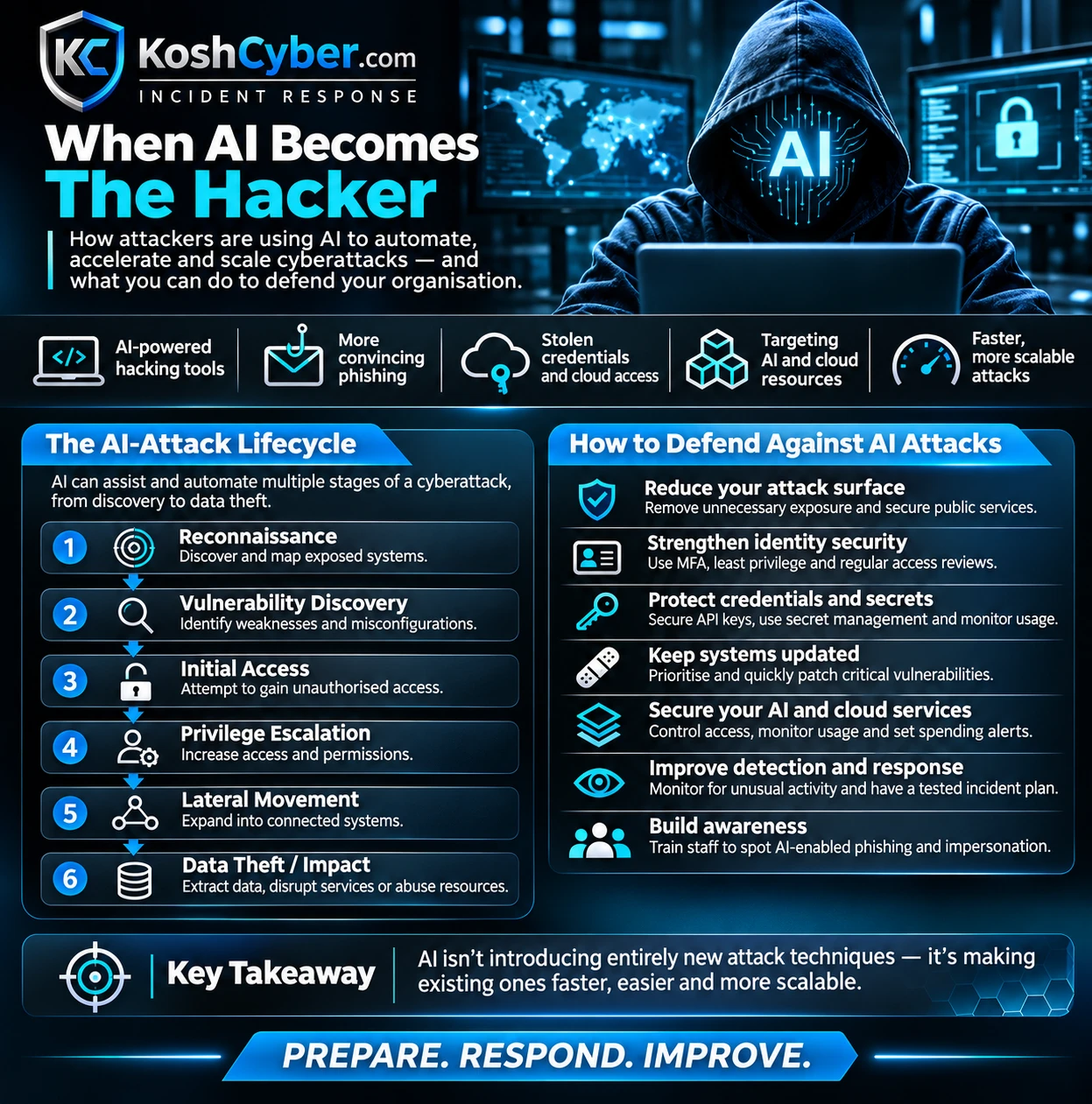
8. How to protect your organisation against AI-powered hackers
Organisations do not necessarily need to purchase an entirely new security platform to begin addressing AI-assisted attacks.
The priority should be strengthening existing security controls, improving visibility and reducing the time required to remediate weaknesses.
1. Reduce your external attack surface
Maintain an accurate inventory of internet-facing infrastructure.
Review externally accessible websites, remote management interfaces, VPN infrastructure, APIs and legacy systems.
Remove unnecessary public exposure and restrict administrative access to appropriately authorised users and networks.
2. Strengthen identity security
Implement strong authentication and minimise unnecessary permissions.
Recommended controls include:
- Phishing-resistant MFA for privileged and other sensitive user accounts.
- Conditional Access policies.
- Role-based access control.
- Privileged Identity Management, where appropriate.
- Regular access reviews.
- Removal of unused accounts and applications.
- Separate administrative and everyday user accounts.
User MFA alone does not protect against the misuse of stolen application credentials. Workload identities require their own security controls.
3. Protect API keys and application secrets
Credentials should never be deliberately embedded in publicly accessible source code.
Organisations should:
- Use dedicated secrets management solutions.
- Enable repository secret scanning and push protection.
- Prefer managed identities or workload identity federation where supported.
- Apply least privilege to service principals.
- Monitor application credential creation and usage.
- Revoke and replace exposed credentials promptly.
Deleting a secret from a repository does not invalidate it. Exposed credentials must be treated as potentially compromised.
4. Improve vulnerability management
AI-assisted automation increases the importance of effective remediation.
Security teams should prioritise vulnerabilities based on:
- Evidence of active exploitation.
- Internet exposure.
- Exploitability.
- Business criticality.
- Access to sensitive information.
- Potential impact on connected systems.
Maintain an emergency patching process for high-risk vulnerabilities and apply appropriate temporary mitigations when permanent remediation cannot be deployed immediately.
5. Secure APIs and web applications
Web-facing services should implement appropriate security controls, including:
- Strong authentication and authorisation.
- Server-side input validation.
- Appropriate request throttling and rate limits.
- Web application firewalls where suitable.
- Automated abuse detection.
- Secure error handling.
- Logging of security-relevant activity.
Rate limiting should account for authenticated identities and sessions, not just source IP addresses.
6. Implement network segmentation
Restrict unnecessary access between systems and environments.
Separating administrative infrastructure, production servers, user devices and sensitive data services can reduce the impact of an initial compromise.
Zero Trust principles can further help limit unauthorised access by requiring explicit verification and appropriate permissions.
7. Improve security monitoring
Collect security telemetry centrally and correlate activity across endpoints, identities, networks and cloud services.
SIEM and XDR solutions can support detection and investigation, but their effectiveness depends on appropriate data collection, configuration and operational processes.
Security teams should regularly test whether their monitoring can identify simulated compromise activity.
8. Protect AI infrastructure
Organisations deploying AI applications should also secure the infrastructure supporting them.
Recommended measures include:
- Restricting access to model endpoints.
- Applying least privilege to AI service identities.
- Protecting AI-related API credentials.
- Monitoring model usage and consumption.
- Configuring billing alerts and appropriate service quotas.
- Restricting the tools and sensitive data available to AI agents.
- Requiring human approval for high-impact automated actions.
Billing alerts provide visibility but should not be assumed to impose a hard spending limit.
9. Strengthen security awareness
AI-generated messages and synthetic media can make traditional visual warning signs less reliable.
Employees should be trained to independently verify unusual requests, particularly those involving:
- Financial transfers.
- Password or MFA resets.
- Sensitive information.
- Changes to supplier payment details.
- Requests claiming to originate from senior management.
Verification should use a trusted communication channel rather than relying solely on the details supplied in the suspicious message.
10. Consider cyber deception
Defensive deception technologies, such as honeytokens, decoy credentials and honeypots, may help identify unauthorised activity.
The NCSC has highlighted deception as a potential defence against agentic offensive frameworks. [1]
These technologies should be deployed as part of a wider detection strategy and must not introduce additional access to production systems.
9. Responding to a suspected AI-assisted cyberattack
An organisation does not need to confirm whether artificial intelligence was involved before initiating its incident response procedures.
The immediate priorities are to understand the activity, limit its impact and protect business operations.
Identification and analysis
- Validate the initial security alert.
- Establish which assets and identities are affected.
- Determine whether unauthorised access has occurred.
- Collect relevant security logs and preserve evidence.
- Assess potential data exposure and business impact.
Containment
- Isolate affected systems where appropriate.
- Revoke compromised credentials and tokens as applicable.
- Restrict access to affected applications and services.
- Disable malicious or compromised application identities where necessary.
- Coordinate containment actions with relevant system owners.
Eradication
- Address the vulnerabilities or misconfigurations that enabled access.
- Remove unauthorised accounts and persistence mechanisms.
- Review privileged access assignments.
- Investigate interconnected systems for additional compromise.
- Replace affected authentication material.
Recovery
- Restore affected services securely.
- Validate that remediation has been effective.
- Apply enhanced monitoring.
- Confirm that legitimate business operations can resume.
Post-incident improvement
- Document the incident timeline and root cause.
- Review detection and response performance.
- Identify control failures.
- Update incident response playbooks.
- Conduct further training and exercises.
This approach reflects established incident response principles. NIST SP 800-61 Revision 3 provides guidance on integrating incident response into wider cybersecurity risk management. [6]
10. AI can also strengthen cyber defence
Artificial intelligence is not exclusively an attacker capability.
Defenders can use AI-assisted technologies to support:
- Security incident summarisation.
- Threat intelligence analysis.
- Vulnerability prioritisation.
- Security alert triage.
- Threat hunting.
- Malicious script analysis.
- Authorised security testing.
- Incident response automation.
However, AI-generated findings should be validated, particularly where automated decisions could affect production systems, privileged access or sensitive information.
Human oversight, appropriate permissions, auditability and controlled deployment remain important.
11. What businesses should be doing now
The following checklist provides a practical starting point for organisations reviewing their readiness against AI-enabled cyber threats.
- [ ] Review all internet-facing assets.
- [ ] Identify unnecessary public services.
- [ ] Prioritise exploitable vulnerabilities.
- [ ] Implement phishing-resistant authentication where appropriate.
- [ ] Review service principals and application permissions.
- [ ] Scan source code repositories for exposed secrets.
- [ ] Review API authentication and rate limiting.
- [ ] Centralise security logging.
- [ ] Monitor cloud and AI resource consumption.
- [ ] Validate network segmentation.
- [ ] Test incident response and containment procedures.
- [ ] Review staff awareness of AI-enabled impersonation.
- [ ] Conduct an incident response tabletop exercise.
- [ ] Assess governance and security controls for organisational AI usage.
Established frameworks such as Cyber Essentials, ISO/IEC 27001 and ISO/IEC 42001 can support structured improvement across technical security, information security management and AI management.
However, certification or framework alignment alone does not guarantee protection against cyberattacks.
Conclusion
AI-assisted cyberattacks are no longer confined to research environments or hypothetical scenarios.
Published investigations from Microsoft, Google, Mandiant and Unit 42 demonstrate that threat actors are already using AI-enabled technologies to support real malicious operations.
The most important lesson is not that traditional cybersecurity has become obsolete.
It is that weaknesses organisations have tolerated for years may now be discovered and exploited much more quickly.
Effective vulnerability management, strong identity security, restricted access, protective monitoring and well-tested incident response procedures remain fundamental.
Organisations should not wait for the next generation of AI-powered attacks before strengthening these controls.
The attack techniques may be familiar. The speed at which they can be executed is changing.
Prepare. Respond. Improve. — with KoshCyber
KoshCyber helps organisations strengthen their cyber resilience through practical incident response guidance, security training, compliance resources and investigation tools.
Explore:
- Incident Assist — guided cybersecurity incident response.
- Incident Response Playbooks — practical guidance for common security incidents.
- Cyber Essentials — strengthen fundamental technical controls.
- AI Governance Readiness — manage AI risks and align with ISO/IEC 42001 requirements.
- Security Awareness Training — improve employee understanding of cybersecurity threats.
Visit https://koshcyber.com
References and further reading
- [1] National Cyber Security Centre — November 2026 — Familiar weaknesses, exploited faster: defending against agentic cyber attacks.
- [2] Microsoft Threat Intelligence — 5 November 2026 — Threat actors use agentic AI tooling to find and abuse exposed secrets.
- [3] Google Threat Intelligence Group — ARTEX and Friends: Enter Agentic Offensive Frameworks.
- [4] Palo Alto Networks Unit 42 — 12 November 2026 — Attackers Use Autonomous AI to Target Semiconductor, Defense and Civil Society Sectors.
- [5] Google Threat Intelligence Group — 16 November 2026 — GTIG AI Threat Tracker: Agentic Threat Activity Crosses a Significant Threshold.
- [6] National Institute of Standards and Technology — April 2025 — NIST SP 800-61 Revision 3: Incident Response Recommendations and Considerations for Cybersecurity Risk Management.
- [7] Google Threat Intelligence Group and Mandiant — 2 November 2026 — The Rise of LLMJacking: How Threat Actors Monetize Compromised Cloud and Model Resources.
- [8] Microsoft Threat Intelligence — 21 October 2026 — AI-driven, large-scale nation-state campaign using ARTEX enables supply chain compromise.
- [9] National Cyber Security Centre — 2026 Annual Review — Continuity and change: A decade of cyber threat.
Research and references reviewed on 25 November 2026.